Last verified: March 2026
The Founding
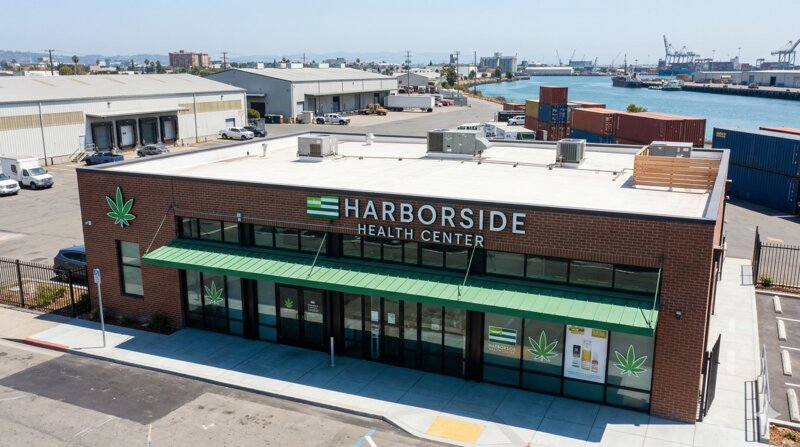
Harborside Health Center opened in 2006 at 1840 Embarcadero in Oakland, founded by Steve DeAngelo and Dave Wedding Dress (who wore a wedding dress daily as a form of protest). It was established as a nonprofit medical cannabis dispensary with a mission that went beyond selling weed: Harborside was designed to prove that a cannabis dispensary could be professional, transparent, and community-serving.
It became the largest nonprofit medical cannabis dispensary in the world. At its peak, Harborside served 300,000 registered patients and generated $25.5 million in annual revenue. The numbers alone were a political argument: here was a cannabis business operating openly, paying taxes, serving patients, and functioning like a legitimate institution.
The Firsts
Harborside was not just big — it was innovative in ways that shaped the entire industry:
- Lab testing: Harborside was one of the first dispensaries in America to require laboratory testing for all cannabis products — before any state law mandated it. DeAngelo believed consumers had a right to know what was in their cannabis.
- CBD products: Harborside was among the first dispensaries to stock and promote CBD products, at a time when most of the industry ignored cannabidiol entirely.
- Pediatric use: Harborside served families of children with Dravet syndrome (severe epilepsy), providing CBD-rich products before Charlotte's Web made pediatric cannabis famous nationally.
Weed Wars (2011)
In December 2011, Discovery Channel premiered Weed Wars, a reality television series following the daily operations of Harborside. The show ran for 4 episodes before being canceled — but those four episodes broadcast the interior of a professional cannabis dispensary to millions of Americans for the first time. Viewers saw not a seedy back room but a clean, organized, patient-focused operation with professional staff. Weed Wars was, effectively, a four-hour commercial for the legitimacy of legal cannabis.
The IRS Battle: $36 Million
Under Section 280E of the Internal Revenue Code — a provision originally designed to prevent drug traffickers from deducting business expenses — the IRS determined that cannabis businesses could not deduct normal operating costs. The IRS audited Harborside and demanded $36 million in back taxes.
Harborside fought. The case went through Tax Court and eventually to the 9th Circuit Court of Appeals, which upheld the IRS's position. The bill was eventually negotiated down to approximately $11 million — still a staggering sum for a nonprofit dispensary. The 280E fight illustrated the fundamental absurdity of cannabis's federal status: a business operating legally under state law, paying state and local taxes, serving hundreds of thousands of patients, was being taxed at an effective rate that no other legal business would survive.
The federal tax code treats us the same as a cocaine trafficker. We cannot deduct our rent, our payroll, our security, our lab testing — nothing.
Steve DeAngelo on Section 280E
Federal Civil Forfeiture (2012)
In 2012, U.S. Attorney Melinda Haag filed civil forfeiture proceedings against the properties housing Harborside's Oakland and San Jose locations, seeking to seize the buildings themselves and shut the dispensary down permanently. It was the nuclear option — not a criminal prosecution, but the seizure of the physical spaces.
The City of Oakland sued the federal government to protect Harborside, arguing that the dispensary was a regulated, tax-paying business that the city wanted operating. It was an extraordinary moment: a city government going to court against the Department of Justice to defend a cannabis dispensary. The case dragged on for years. In 2016, the Department of Justice dropped the forfeiture case. Harborside survived.
The First Legal Gram
On January 1, 2018, when Proposition 64 took effect and adult-use cannabis sales became legal in California, Steve DeAngelo sold the first gram of legal recreational cannabis in the state at Harborside Oakland. The line stretched around the block. Media from around the world covered the moment. After two decades of raids, lawsuits, tax battles, and federal threats, the dispensary that had endured all of it made the first legal sale.
The Corporate Era and Bankruptcy
In 2019, Harborside went public on the Canadian Securities Exchange (CSE) as part of the cannabis industry's rush to public markets. In 2022, the parent company was acquired by StateHouse Holdings, a multi-state cannabis operator.
Steve DeAngelo separated from Harborside in December 2020, ending the founder's direct involvement with the dispensary he had built. StateHouse Holdings subsequently accumulated over $100 million in debt and filed for bankruptcy in October 2024. The company was delisted from the CSE in June 2025.
But here is the part that matters: all four Harborside stores are still operating as of March 2026. Through federal raids, a $36 million IRS battle, civil forfeiture, corporate acquisition, and parent company bankruptcy, the doors at 1840 Embarcadero have never permanently closed.
Steve DeAngelo: Beyond Harborside
DeAngelo's impact extends far beyond one dispensary:
- Steep Hill Labs: Co-founded one of the first commercial cannabis testing laboratories in America.
- Arcview Group: Co-founded the cannabis investment network that has facilitated over $300 million in investment into cannabis companies.
- Last Prisoner Project: Co-founded the organization that advocates for the release of people incarcerated for cannabis offenses.
Former San Francisco Mayor Willie Brown called DeAngelo the "Father of the Legal Cannabis Industry" — a title that reflects not just Harborside but the entire ecosystem DeAngelo helped build around it.
Steve DeAngelo is the Father of the Legal Cannabis Industry.
Willie Brown, former Mayor of San Francisco
Why It Matters
Harborside is not just a dispensary. It is a survival story. Every institution that fought for cannabis legalization took damage — from the feds, from the IRS, from the corporate market, from the illicit market. Most did not survive. Harborside absorbed all of it. It was raided, sued, taxed at confiscatory rates, dragged through bankruptcy, and stripped of its founder. And the doors at 1840 Embarcadero still open every morning.
That persistence is the East Bay in one address.
Learn More
For in-depth cannabis education, dosing guides, safety information, and research summaries, visit our partner site TryCannabis.org
Related on this site: California Cannabis Law, Cookies & Bay Genetics, First Cannabis Equity Program.